Most Raleigh houses sit on a slab or a crawl space because the ground here never freezes deep enough to force a builder to dig, and the red clay and shallow rock that cover the Piedmont make a dry basement expensive to build. Basements do exist in the Triangle, mostly on sloped lots in North Raleigh, Chapel Hill and parts of Durham and Holly Springs, and a few builders offer them as an option when the grade allows.
If you are moving here from Chicago, Boston, New Jersey or Ohio, the missing basement is usually the first thing you notice on a showing. We hear it every week, often as a worry: where does the furnace go, where do the kids play in February, where does the water go when it storms. The answers are all reasonable, but they are different from what you grew up with, and they change what you should inspect.
Here is why Triangle builders skip the basement, where you can still find one, and what a crawl space or slab means for the house you are about to buy.
How rare are basements in the Triangle really?
Rarer than most newcomers guess, and getting rarer. The Census Bureau’s Characteristics of New Housing survey tracks the foundation under every new single-family house completed in the country. In the South region in 2025, 88 percent of new houses were built on a slab, 8 percent on a crawl space and just 4 percent with a full or partial basement. Twenty years earlier, in 2005, 12 percent of new Southern houses had a basement and 19 percent sat on a crawl space. Compare the Midwest, where 50 percent of new houses completed in 2025 had a basement, and the Northeast at 53 percent (U.S. Census Bureau, Characteristics of New Housing, 2025 data published July 1, 2026).
- New single-family houses completed in the South with a basement: 4 percent in 2025, down from 12 percent in 2005 U.S. Census Bureau, Characteristics of New Housing, July 2026
- Slab foundations in the South: 88 percent of 2025 completions; crawl spaces 8 percent U.S. Census Bureau, Characteristics of New Housing, July 2026
- Basements in the Midwest: 50 percent of 2025 completions; Northeast 53 percent; United States 16 percent U.S. Census Bureau, Characteristics of New Housing, July 2026
Those are regional numbers, not Wake County numbers, and the Triangle’s older neighborhoods skew toward crawl spaces rather than slabs. Walk Five Points, Hayes Barton or Trinity Park and nearly every pre-1980 house is raised on brick piers with a vented crawl space underneath. Walk a 2024 Pulte or Lennar community in Wendell or Holly Springs and nearly every house is on a monolithic slab. Basements are the exception in both eras.
Why do builders here skip the basement?
Two reasons, one about the ground and one about money, and they reinforce each other.
The first is frost. In the upper Midwest and the Northeast, footings must go below the frost line, which means deep excavation before the house even starts. Once a builder has dug that far, finishing the hole as a basement costs relatively little extra. In North Carolina the ground rarely freezes more than a few inches. The state’s residential code requires a minimum footing depth of just 12 inches below finished grade (NC Residential Code Section R403.1.4, as cited by the City of Fayetteville Inspections Department). A Raleigh builder can pour footings and a slab in a day. A basement here is not a byproduct of the foundation; it is a separate project that adds excavation, waterproofing, drainage and a full story of poured or block wall.
The second is the soil. Much of the Piedmont, including large parts of Wake and Orange counties, sits on Cecil soil, North Carolina’s official state soil, which is a thin layer of sandy loam over a deep, red, kaolinite clay subsoil. More than 10 million acres of it are mapped from Virginia to Alabama (USDA Natural Resources Conservation Service, Cecil series description). That clay drains slowly, holds water against anything buried in it, and in many spots gives way to weathered rock within a few feet. Durham and Chatham counties and the western edge of Wake add a second problem: the Triassic basin, where the bedrock is clay-rich sandstone and siltstone that holds little water and moves it poorly, which is why septic percolation tests fail so often there (NC Department of Environmental Quality, Guide for Homeowners in the Triassic Basins). Dig a basement into either of those and you have built a bathtub that needs a perimeter drain, a sump pump and a waterproofing membrane to stay dry through a Carolina summer.
Put the two together and a basement in Wake County adds a large cost to a build without adding square footage that appraisers value as highly as above-grade space. Production builders, who sell on price per square foot, make the obvious choice.
Where can you find a basement in the Triangle?
Topography is the answer. A basement pencils out when the lot drops away enough that one side of the lower level can open at grade as a walkout, because the builder is digging less and the space counts as living area with windows and a door. That is why most Triangle basements are on hillside lots: the ridges of North Raleigh between Falls of Neuse Road and Six Forks Road, the wooded lots around Chapel Hill and the Duke Forest edge of Durham, the slopes above Jordan Lake and Falls Lake, and newer communities in Holly Springs and Apex where builders grade lots specifically for walkouts.
New construction is where the option is easiest to control. Lennar’s Norris Crossing in Holly Springs, for example, sells five-bedroom plans of 3,163 to 4,034 square feet with basement options on tree-lined lots, priced from the high $600,000s (Lennar, as published November 16, 2026; see our Lennar page). Several custom and semi-custom builders will build a walkout basement on a sloped lot if you ask early, before the lot is graded. We cover how to approach that conversation in our Triangle new construction guide. On the resale side, ask us to filter the MLS for basement and walkout keywords; the inventory is small, which also means a finished, dry walkout basement is a real selling point when you list.
What should a buyer check instead?
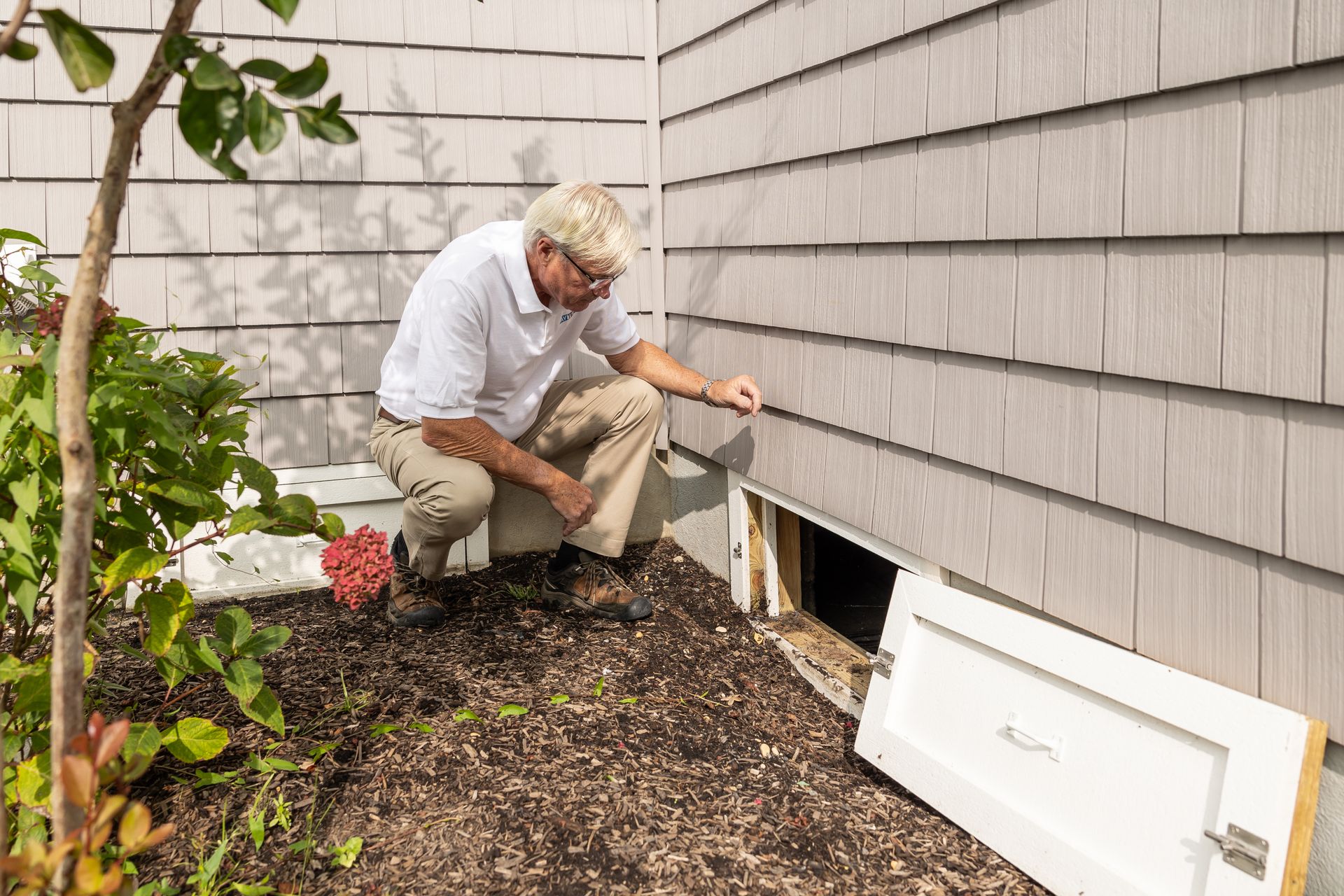
If the house has a crawl space, that is where your inspection money goes. North Carolina summers push humid air under the house, where it condenses on cool ductwork and joists, so look for standing water, fungal growth on the floor framing, sagging insulation and rusted HVAC equipment. Many Triangle sellers have had the crawl space encapsulated with a vapor barrier and a dehumidifier, and a good encapsulation is worth paying for. A crawl space also gives you something a slab cannot: access to plumbing and ductwork without cutting concrete.
If the house is on a slab, the questions change. Ask when the water heater was replaced and where it sits, because a leak on a slab goes into the floor rather than a basement drain. Ask whether the lot grades away from the house on all sides, since there is no below-grade wall to shed water. And check for post-tension cables on newer slabs before anyone drills into the floor. Our post on well and septic homes in the Triangle covers the soil issues that matter most in Chatham and Johnston counties, where percolation decides what you can build.
Basements in the Triangle are not the dry, cool rooms you remember from Michigan. Even a well-built walkout here needs a working sump pump, a dehumidifier and a perimeter drain that someone has maintained, and the inspection should include a moisture reading on the lower-level walls. Buyers also tend to overpay for finished basement square footage, which appraisers and future buyers in this market discount compared with above-grade space. If you want the storage and the bonus room, a Triangle house with a third-floor walk-up attic or a detached garage with a loft often delivers the same space with none of the water risk.
Related questions people also ask
Do any houses in Raleigh have basements?
Yes, but they are a small minority. Basements in the Raleigh area are found mostly on sloped lots where the lower level can open at grade as a walkout, especially in hilly parts of North Raleigh, Chapel Hill, Durham and newer hillside communities in Holly Springs and Apex. A few builders offer a basement as an option on lots that are graded for one.
Is a crawl space or a slab better in North Carolina?
Neither is better in every case. A crawl space gives you access to plumbing and ductwork and keeps the floor framing off the ground, but it needs moisture control and often a vapor barrier and dehumidifier in the Triangle’s humid summers. A slab is cheaper to build and has nothing underneath to get wet, but plumbing leaks are harder to reach and the lot must drain away from the house on every side.
Why are there no basements in the South?
Southern ground rarely freezes deep, so building codes let footings stay shallow and builders never have to dig far enough to make a basement a cheap add-on. The clay soils common across the Piedmont also drain slowly and hold water against buried walls, which makes a dry basement expensive to waterproof. Builders who sell on price per square foot put the money into above-grade space instead.
Decide what you actually want from a basement, whether it is storage, a playroom, a home office or a safe room, and tell us. We can search the MLS for walkout basements in your price range and show you Triangle houses that deliver the same space above grade, then walk the crawl space or slab with you on the ones you like. We are happy to talk through what you are seeing on showings.
Sources: U.S. Census Bureau, Characteristics of New Housing, Type of Foundation in New Single-Family Houses Completed, 2025 annual data published July 1, 2026; USDA Natural Resources Conservation Service, Official Series Description for the Cecil series; NC Department of Environmental Quality, Guide for Homeowners in the Triassic Basins of North Carolina; City of Fayetteville Inspections Department, residential guide citing NC Residential Code Section R403.1.4; Lennar, Norris Crossing community page, as published November 16, 2026, via our Lennar page.