Usually yes, but almost never from the builder and never with only one approval. A pool at a new Wilmington-area home needs a building permit that includes the barrier, your homeowners association’s architectural approval, and enough unused built-upon area on your lot under the subdivision’s stormwater permit.
That third one is the surprise. Buyers expect the HOA to be the hurdle. In Brunswick and New Hanover counties the harder limit is often a number written on the subdivision plat that nobody mentioned at the design center: how many square feet of impervious surface your particular lot is allowed to have.
We raise this with buyers before they pick a homesite, because it is far easier to choose a lot with room for a pool than to find room on a lot that has already been built out.
The built-upon area limit is the real constraint
Most newer subdivisions on this coast operate under a state or county stormwater permit, and that permit allocates a maximum built-upon area to each lot. The house, the driveway, the walkway and the patio all draw from the same allowance. By the time a 2,400 square foot house, a two-car driveway and a rear patio are finished, a surprising number of lots have very little allowance left.
Here is the part that works in your favor. North Carolina law says specifically what does not count as built-upon area, and a pool is largely on that list.
- The water area of a swimming pool and a slatted deck are excluded from built-upon area by state law NC General Statutes 143-214.7D, read November 2026
- Also excluded: number 57 stone laid at least four inches thick over geotextile fabric, and artificial turf installed over a pervious surface per the manufacturer’s specifications NC General Statutes 143-214.7D, read November 2026
- Brunswick County’s stormwater ordinance carries the same exclusions for a slatted wood deck, the water area of a pool, and number 57 stone Brunswick County Stormwater Quality Management and Discharge Control ordinance, read November 2026
- A local government may not adopt a narrower definition of built-upon area than the state’s NC General Statutes 143-214.7D(d), read November 2026
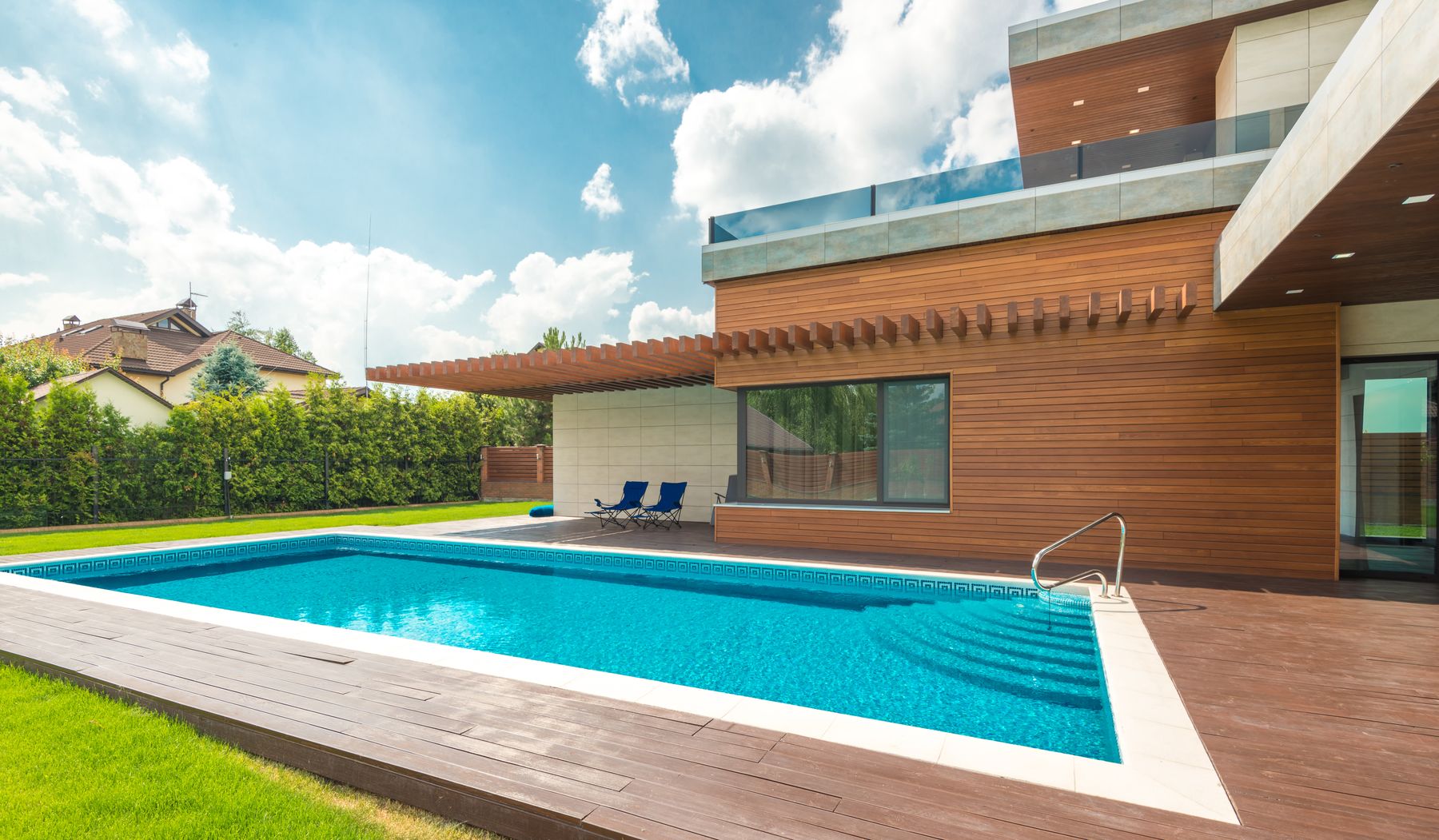
So the water is free, in stormwater terms. The concrete apron around it is not. A 14 by 28 foot pool with a four foot concrete deck all the way around covers a 22 by 36 foot footprint, and the decking alone is about 400 square feet of impervious surface even though the water itself counts for none of it. Swap that concrete for a slatted deck, number 57 stone over fabric, or artificial turf over a pervious base, and the same pool can fit inside an allowance that concrete would blow through.
That is a conversation to have with the county before you sign a pool contract, not after. Ask the county stormwater office for your lot’s allocated maximum built-upon area and what the as-built house already used.
The permit includes the fence, whether you planned one or not
North Carolina treats the barrier as part of the pool. The Office of the State Fire Marshal addressed this directly: barrier requirements sit in Appendix V, section AV105 of the North Carolina Residential Code, and the state’s answer was that a separate barrier permit cannot be issued because the barrier is part of the same pool permit.
In practice that means your permit drawing has to show the enclosure, the gates and their hardware, and the inspector will look at it before the final sign-off. Budget for it. A fence is not an optional phase two, and a neighbor’s existing fence usually will not satisfy the requirement on its own.
What builders will and will not do
The production builders working across New Hanover, Brunswick and Pender counties generally do not build pools. Logan Homes, Mungo Homes, HHHunt Homes, Stevens Fine Homes, Bill Clark Homes and Trusst Builder Group each run their own community lineups and incentives, and our new construction pages track what each is offering right now. What they will sometimes do is identify which homesites have the depth, the setbacks and the allowance to take a pool later, which is worth asking about on your first visit rather than at your design appointment.
Two builder-side details to check before you dig. First, ask in writing how excavation near the foundation and the lot’s grading affects your warranty, because drainage is the thing most likely to be excluded afterward. Second, wait for the final grade, sod and any stormwater infrastructure to be complete and accepted. We have watched buyers pay twice because a pool contractor worked a lot that the builder had not finished stabilizing. Our new construction guide covers the rest of the timeline.
Some lots simply cannot take a pool, and no amount of design work changes that. If the as-built house, driveway and patio already consumed the lot’s allocation, you cannot borrow allowance from a neighbor, because the allocation is part of an enforceable permit rather than an informal understanding between owners. Easements are the other quiet killer: drainage, utility and access easements commonly run along rear and side lot lines in new Wilmington-area communities, and you cannot build over them. Then there is the association. An architectural review committee can deny a pool on aesthetic grounds even when the county would permit it, and in a community where the builder still controls the board, that decision may be made by the builder rather than by your neighbors. Read the declaration before you buy the lot, not after you have a pool contract in hand. If a pool is genuinely non-negotiable for you, it may be cheaper and faster to buy an existing home that already has one.
Related questions people also ask
Does a swimming pool count as impervious surface in North Carolina?
The water area of the pool does not count as built-upon area under state law, and neither does a slatted deck. What does count is the concrete or paver decking around the pool, along with any equipment pad and walkway that connects it to the house. This matters because most subdivisions permitted for stormwater assign each lot a maximum built-upon area, and the decking is what consumes it. Designing the surround in materials the statute excludes is the usual way to fit a pool on a tight allowance.
Do I need a permit to put a pool in my backyard in Wilmington?
Yes. A residential in-ground pool requires a building permit from the jurisdiction where the property sits, and in North Carolina the required barrier is reviewed as part of that same permit rather than separately. Electrical work for the pump and lighting is inspected as well. Your zoning district also sets setbacks that control how close the pool and its equipment can sit to property lines. Confirm both the permit requirements and the setbacks with the county or city before you sign a contract with a pool builder.
Can an HOA stop me from putting in a pool?
Often, yes. Most newer communities in this area give an architectural review committee authority over exterior changes, and that authority typically covers pools, fences, decking materials and sometimes equipment screening. The committee can deny a request or impose conditions, and its decision stands separately from whatever the county permits. While the builder still controls the association, which is common in the first years of a community, the builder effectively makes that call. Read the declaration and the architectural guidelines before you commit.
Before you choose a homesite, ask three questions in writing: what built-upon area is allocated to this lot, where the easements run, and what the association’s architectural guidelines say about pools. We ask those for our new construction buyers as a matter of course, and we are glad to do it on a community you are already considering.
Sources: North Carolina General Statutes 143-214.7D, Limitations on built-upon area requirements, read November 22, 2026; Brunswick County Stormwater Quality Management and Discharge Control ordinance, read November 22, 2026; North Carolina Office of the State Fire Marshal, Engineering Division formal interpretation on swimming pool barrier permits, 2018 NC Residential Code section AV105, dated March 20, 2019; Tidal Realty Partners new construction pages, November 2026.