The honest list is short: insurance and the cost of carrying a house have climbed faster than local pay, hurricane season is an annual budget line rather than a rare risk, and the road network is strained in ways a beach town’s reputation does not prepare you for. We live here on purpose and we would not trade it, but every one of those items belongs in your budget before you tour a single house.
We get asked for the downsides more often than the highlights, usually by someone two weeks out from a house-hunting trip who has already read twenty pages telling them how wonderful it is here. Fair enough. The people who are still happy here three years later are the ones who priced the hard parts in advance instead of discovering them at the closing table. So here is the version we give buyers over the phone, with the numbers we can source this month.
The cost of carrying a house has moved faster than local pay
This is the real downside, and it is not the one most people expect. Wilmington is not expensive by Boston or Bergen County standards. It is expensive relative to what Wilmington pays.
- Median household income, New Hanover County: $77,098 U.S. Census Bureau Small Area Income and Poverty Estimates via FRED, 2024 data, read October 18, 2026
- Median listing price, New Hanover County: $518,751 in September 2026 Realtor.com via FRED, September 2026
- Median sale price $464,000, down 1.3 percent year over year, 61 days on market against 34 a year ago, 1,251 active listings Our New Hanover County market update, three months ending September 2026
- 30-year fixed mortgage 7.40 percent, unchanged on the week and up 74 basis points in eight weeks Freddie Mac weekly survey, week ending October 15, 2026
- Combined property tax rate inside the Wilmington city limits: 63.75 cents per $100, the county’s 30.6 cents plus the city’s 33.15 cents New Hanover County fiscal 2026-2027 rates, reported by Port City Daily, July 10, 2026
- Homeowners insurance in the beach territory covering New Hanover, Brunswick, Pender, Carteret and Onslow counties rose 16 percent on June 1, 2025 and 15.9 percent on June 1, 2026 NC Department of Insurance homeowners rate settlement, announced January 17, 2025
Put those together. A $464,000 purchase with 20 percent down carries about $2,570 a month in principal and interest at this week’s rate, on the arithmetic in our New Hanover County market update. Add roughly $247 a month in county and city property tax at 63.75 cents, then add a homeowners policy that has absorbed two consecutive double-digit increases in the beach territory. That is the number a Wilmington salary has to cover, and the median household here earns $77,098.
The two-year run of insurance increases is the part that catches relocating buyers, because it is not in the listing price and it is not in the mortgage calculator. Get a real homeowners quote on the specific address during due diligence rather than budgeting from a national average. The quote on a 1978 house in Pine Valley and the quote on a 2021 house in Riverlights are not in the same neighborhood, and neither is the one on a house with a nine-year-old roof.
If a Wilmington number does not work, the answer is usually a county line rather than a different metro. Brunswick County’s median sale price is $394,000 and Pender County’s is $499,000 on the same three months, and the trade is commute time. Our guide to the best neighborhoods in Wilmington for every kind of buyer walks through which areas actually hold at which price.
Hurricane season is a budget line, not a background risk
Everyone knows the coast gets storms. What people underestimate is how much of the annual cost of living here is storm-related, every year, whether or not anything hits.
Three separate policies can apply to one house: homeowners, which covers wind and hail subject to a separate named-storm deductible; flood, which is a different policy entirely and is not optional if you are financing a house in a Special Flood Hazard Area; and in some cases a wind-only policy through the North Carolina Insurance Underwriting Association. Our guide to coastal North Carolina homeowners insurance works through the named-storm deductible math, which is the part that actually hurts after a storm, because it is a percentage of your dwelling coverage rather than a flat dollar amount.
Flood zone is parcel-specific, not neighborhood-specific. We have had two houses on the same street come back in different zones, which changes the premium and whether an elevation certificate is worth ordering. Our Wilmington flood zone and flood insurance guide explains how the determination is made and what an elevation certificate can do to a quote. The other limit worth knowing before you shop: the National Flood Insurance Program caps building coverage on a single-family home at $250,000, so above that figure the gap is yours or it belongs to an excess policy.
Then there is the week itself. Evacuations here are real, schools close, and if you work remotely you will lose power at some point. Most of us plan for it, which is the point: plan for it.
The roads are the complaint we hear most, and the fix is not funded
Wilmington sits in a county hemmed in by a river on one side and an ocean on the other, which means traffic concentrates on a handful of corridors. College Road and Market Street are the two everybody complains about, and the complaints are supported by the state’s own counts.
- College Road, between Martin Luther King Jr. Parkway and Spring View Drive: 54,400 vehicles per day, projected to reach 88,900 by 2045 NCDOT project U-5792 page, 2024 annual average daily traffic, read October 18, 2026
- NCDOT schedule for that project: right-of-way acquisition beginning spring 2026, construction summer 2029 NCDOT project U-5792 page, read October 18, 2026
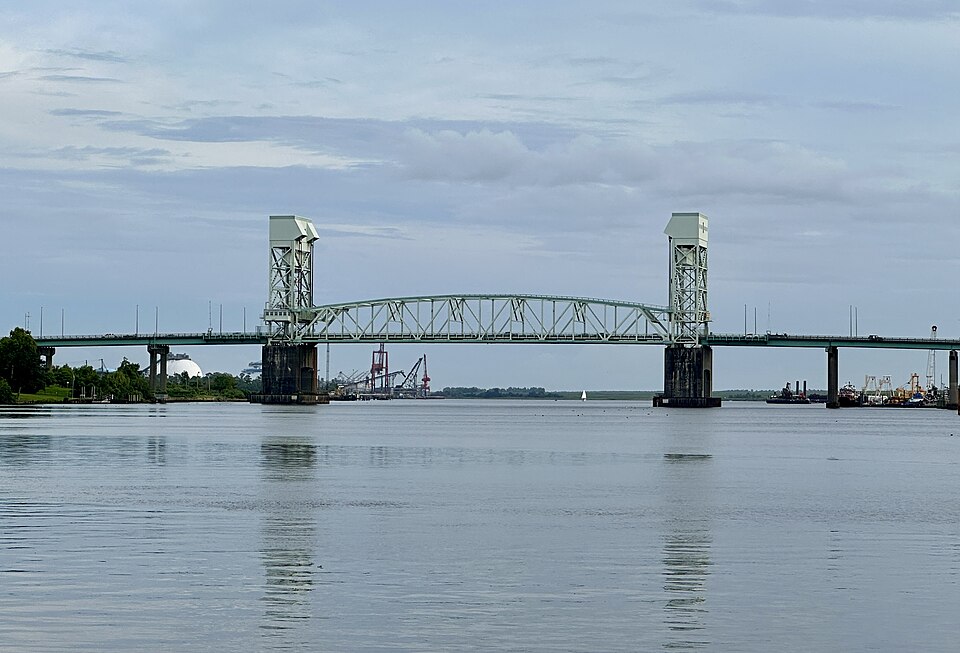
- Cape Fear Memorial Bridge replacement estimate: about $1.1 billion, up from about $450 million in 2024, with $85 million allocated in the State Transportation Improvement Program WECT, July 29 and July 30, 2026; Port City Daily, July 29, 2026
- A $242 million federal grant awarded in July 2024 requires the project to be shovel ready by September 2027, and roughly $773 million of the remaining cost would come from tolls Port City Daily, July 3, 2026; WECT, July 30, 2026
Read the bridge numbers carefully, because they are the clearest picture of what the next decade of driving here looks like. NCDOT rejected an unsolicited private proposal in July 2026 and is pursuing a traditional toll project, and the regional transportation authority faces a vote on whether to consent to tolling or withdraw the project, which would take state funding and planning with it. Nobody can tell you today what the toll will be or whether it will exist. What we can tell you is that the Cape Fear Memorial Bridge is the main connection between downtown and Brunswick County, so anybody buying in Leland and working in Wilmington should be following that decision rather than assuming it will not touch them.
The practical advice is boring and it works. Drive your actual commute, at the actual hour, before you write an offer. A house off Middle Sound Loop Road and a house in Ogden can look like the same drive on a map and be twenty minutes apart at 7:45 on a Tuesday.
What the summer does to the places people want to live
From Memorial Day through Labor Day the beach towns fill and the roads to them carry it. If you buy at Wrightsville Beach, Carolina Beach or Kure Beach, parking near your own house in July is a genuine consideration, and so is the short-term rental activity on your street. On the mainland the effect is milder and mostly shows up as traffic on Eastwood Road and Oleander Drive and a wait for a table. The season is also what funds a good deal of what people move here for, from beach nourishment to restaurants that could not survive on the year-round population alone. Our moving to Wilmington pages walk through the seasonal rhythm by area, and the buyers who struggle with it are usually the ones who toured in February and assumed February was the whole year.
Two of the costs above are genuinely unknowable right now. Nobody can tell you where the 30-year mortgage goes from 7.40 percent, and nobody can tell you where coastal homeowners rates settle after two consecutive double-digit increases in the beach territory. If your budget only works assuming rates fall or insurance flattens, it does not work. The other honest caveat is that for some buyers the right answer is not Wilmington at all. If your must-haves are a short commute, a low tax rate and a newer house, Brunswick County at a $394,000 median or an unincorporated New Hanover address outside the city rate will stretch your money further than the city limits will, and we will tell you that before we tell you anything else.
Related questions people also ask
Is Wilmington NC too expensive for a family moving from out of state?
That depends almost entirely on where your income comes from. Families moving with a remote salary set somewhere else usually find Wilmington comfortable, because the housing cost is well below the Northeast and the Mid-Atlantic while the house itself is often newer and larger. Families who plan to earn their income locally have a harder arithmetic problem, because wages here have not kept pace with what houses cost. The practical test is to price the specific house you want, including a real insurance quote and the correct municipal tax rate, against the job offer you actually have rather than against a cost-of-living index.
Does everyone in Wilmington need flood insurance?
No. Flood insurance is required by lenders when the house sits in a Special Flood Hazard Area, and large parts of the Wilmington area do not. The complication is that zone is determined parcel by parcel rather than by neighborhood, so two houses on the same street can carry different requirements and very different premiums. Order the flood determination early in due diligence, and if the house is in a mapped zone, ask whether an elevation certificate exists before you accept the first quote you are given.
Is traffic in Wilmington getting better or worse?
Both, depending on the corridor and the decade you are willing to wait. Several state projects are moving through design and right-of-way on the busiest roads, which will help when they are built, and the schedules put most of that construction years out. In the meantime growth is adding cars faster than lanes are being added, and the replacement of the main bridge to Brunswick County is still unfunded apart from a toll plan that has not been approved. Treat the commute you drive today as the commute you are buying, not as a problem somebody else will solve before you move in.
Before you tour anything, price one specific house all the way through: purchase price, the correct county and municipal tax rate, a real insurance quote on that address, and a flood determination. If the number works, the downsides on this page are things you manage rather than things that surprise you. Send us the address or the area you are looking at and we will build that number with you, honestly, including the version where the answer is a different county.
Sources: Our New Hanover County market update, three months ending September 2026. Freddie Mac weekly mortgage market survey, week ending October 15, 2026, via our monthly mortgage update. U.S. Census Bureau Small Area Income and Poverty Estimates via FRED, 2024 data, read October 18, 2026. Realtor.com via FRED, median listing price, New Hanover County, September 2026. New Hanover County fiscal 2026-2027 property tax rates, reported by Port City Daily, July 10, 2026. NC Department of Insurance homeowners rate settlement, announced January 17, 2025. NCDOT project U-5792 page, 2024 annual average daily traffic and project schedule, read October 18, 2026. WECT, July 29 and July 30, 2026, and Port City Daily, July 3 and July 29, 2026, on the Cape Fear Memorial Bridge replacement. FEMA National Flood Insurance Program building coverage limit.