If you own the lot while the house goes up, you pay tax on the lot, and the house is added to the roll as of the January 1 after it exists, at whatever stage of completion it has reached. If the builder owns the land and you buy the finished house, you pay nothing until you own it, and your first full-year bill will be much larger than the one the builder was paying.
This question comes up on almost every build we represent, usually right after a buyer sees the seller’s current tax bill in the listing and wonders why it says $412. The answer is that North Carolina taxes real property on a January 1 snapshot, and a lot with no house on it is a cheap snapshot. Understanding that one rule tells you what your bill will do in each of the next three years.
There are really two situations, and they produce different answers.
The rule everything else follows: January 1
Under G.S. 105-285, all property subject to ad valorem taxation is listed annually, and the value of real property is determined as of January 1 of the years prescribed by the revaluation statutes. Ownership is determined annually as of January 1 as well. North Carolina Department of Revenue guidance on the subject is direct about construction: improvements are assessed as they stand on January 1, regardless of the stage of completion.
So a house that is framed on January 1 is taxed as a framed house for that year. A slab is taxed as a slab. A bare lot is taxed as a bare lot. Nothing you finish in February changes the bill that was set in January.
- Real property value and ownership are determined as of January 1 each year N.C. General Statutes G.S. 105-285(a) and (d), read November 18, 2026
- Improvements are assessed as of January 1 regardless of the stage of completion, and a certificate of occupancy is not required for the builder exclusion to apply N.C. Department of Revenue guidance on S.L. 2015-223
- New Hanover County FY 2026-27 rate: 0.3060 per $100, plus 0.3315 inside the Wilmington city limits or 0.0725 for fire services outside a municipality New Hanover County and City of Wilmington adopted FY 2026-27 rates
- Brunswick County: 0.3420 per $100, with township and municipal rates on top, and fire service billed separately as a fee on heated square footage Brunswick County tax rate page, 2026
Case one: the builder owns the lot and you buy the finished house
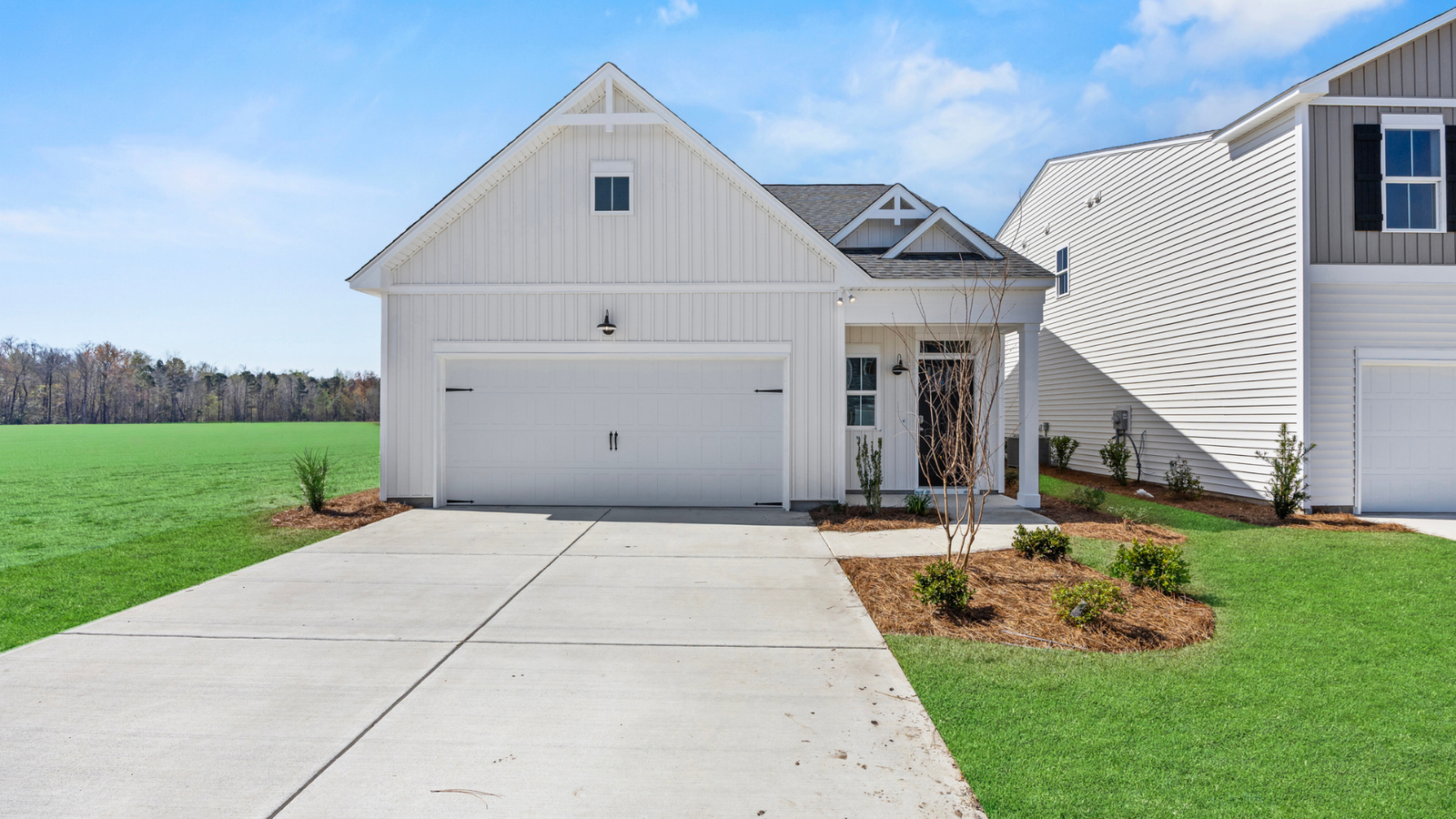
This is most Logan Homes, Mungo Homes, HHHunt and Bill Clark purchases in Leland, Hampstead and the Wilmington production communities, whether you pick a plan on a lot the builder owns or buy a spec that is already standing.
While the builder owns it, the builder is the taxpayer, and the builder gets a break you do not. G.S. 105-277.02 excludes from taxation any increase in the value of residential real property held for sale by a builder that is attributable to subdivision of the property, non-building improvements such as grading, streets and utilities, or construction of a new single-family home. The exclusion runs as long as the builder holds the property for sale, and in no event more than three years. The builder has to apply for it annually.
That is why the tax figure in the listing looks implausibly small. It is often the pre-construction land value, with the entire house excluded. The moment you close, the exclusion ends for that parcel, and your bill reflects a house.
What that means in practice for your first two years:
You will usually be billed a prorated share at closing based on the current year’s small amount, and you may get one more bill at something close to the lot-only figure. Then the January 1 after closing arrives, the house is on the roll in your name at full value, and the bill jumps. If your taxes are escrowed, the escrow was often set on the low figure, so the shortage notice arrives with the new bill. We tell every new-construction buyer to ask the lender to escrow against the finished assessed value from the start, and to put the likely figure in writing. Multiply the expected assessed value by the combined rate for that jurisdiction and you will be close enough to plan.
Case two: you own the lot and build on it
If you bought a lot in a community like Hampstead or out in Pender County and are building with a custom builder, you are the taxpayer the whole way through, and the builder’s exclusion does not travel to you. It is an exclusion for property a builder holds for sale, not for a homeowner building a residence.
So you pay tax on the lot for every year you own it. Then, on the first January 1 after construction starts, you are taxed on the lot plus whatever has been built, at its stage of completion. The year after that, assuming the house is finished, you are taxed on the finished house. Buyers who close on a lot in the spring and break ground in the summer are often surprised by the following year’s bill, because they were mentally still paying for dirt.
One timing detail worth knowing if you buy a lot from a tax-exempt owner, which happens with land coming out of a government or institutional holding. G.S. 105-285(d) says that when real property that was not taxable on January 1 because of its exempt status is acquired after January 1 but before July 1, the buyer lists it as of the acquisition date, it is appraised at its true value as of the January 1 preceding, and it is taxed for the fiscal year beginning July 1 of the year it was acquired. That is a narrow situation, but it catches people who assumed the first bill would not arrive for a year.
What to ask, and when
Three questions, and all of them are better asked before you sign than after.
Ask the builder’s sales manager what the current tax bill on the parcel is and whether the builder’s exclusion is on it this year. Ask your lender to set escrow against the expected finished value rather than the current bill, and to show you the monthly figure both ways. And ask the county tax office what the assessed value is likely to be once the house is on the roll. In our experience the tax offices in all three counties will talk through the mechanics on the phone, and a ten-minute call beats a surprise in year two. Our new construction guide has the rest of the questions we ask on a build, and the builder pages cover what each of our builders is offering right now.
County practice is where the clean statutory rule gets messy. Counties differ in how quickly they discover and add new construction, how they handle a house that was half built on January 1, and whether a supplemental bill follows. We have seen builds where the house did not appear on the roll for an extra year, which feels like a win until the catch-up arrives. We are brokers, not tax assessors or attorneys: for a specific parcel, call the county tax office, and for anything involving an exemption, a trust or an estate, call a North Carolina attorney. Also note that a revaluation year resets everything. New Hanover County revalues on its own cycle, and a reassessment can move your bill more than finishing your house did.
Related questions people also ask
Why is the tax bill on a new construction listing so low?
Because it usually reflects land only. North Carolina law lets a builder exclude from taxation the increase in value attributable to subdividing the land, to non-building improvements like streets and utilities, and to constructing a new single-family home, for as long as the builder holds the property for sale and for no more than three years. Once you buy the house that exclusion ends, so treat the figure in the listing as the builder’s bill rather than a forecast of yours.
Do I pay property taxes at closing on a new build?
Typically you reimburse the seller for the portion of the current year’s taxes covering the days after closing, or receive a credit for days before it, calculated on whatever the current bill is. On a new build that proration is often based on a small land-only figure, which means the number at closing tells you very little about your eventual annual cost. Ask the closing attorney how the proration was calculated and ask the lender separately what the escrow assumes.
Will my escrow payment change after my first full year in a new home?
Very often yes, and upward. If the escrow account was funded using a tax figure that predated the finished house, the servicer collects too little for the first cycle and then raises the monthly payment to cover both the higher bill and the shortage. You can avoid most of the shock by asking the lender before closing to escrow against the expected assessed value of the completed home.
Before you sign a build contract, get three figures in writing: the parcel’s current tax bill, the expected assessed value once the house is on the roll, and the monthly escrow your lender will collect against that higher number. If you want us to run those numbers for a specific community and builder, our team represents buyers on new construction every week and will walk through it with you.
Sources: N.C. General Statutes G.S. 105-285(a), (b) and (d), read November 18, 2026; G.S. 105-277.02, builders’ inventory exclusion for residential and commercial real property, read November 18, 2026; N.C. Department of Revenue guidance on S.L. 2015-223 regarding assessment of partially complete improvements and the builder exclusion; New Hanover County adopted FY 2026-27 county, fire services and City of Wilmington rates; Brunswick County tax rate page, 2026. Related reading: our new construction guide and our comparison of new construction and resale.