Yes, if you want to walk to work, dinner and a show, you are comfortable in a condo or townhome, and you can carry HOA dues of $350 to $800 a month on top of the mortgage. Downtown Raleigh is growing fast and getting more to do every quarter, but it is still mostly a renter’s district with a thin supply of condos, so buying there is a lifestyle decision first and an investment second.
Downtown Raleigh’s population has roughly doubled in a little more than a decade. The Downtown Raleigh Alliance counts about 16,841 residents, up more than 1,000 in the past year, and says another 7,419 could arrive by 2031 if the proposed residential projects get built (Downtown Raleigh Alliance State of Downtown report, August 26, 2026). More than 5,000 residential units have opened since 2020 alone (WUNC, August 26, 2026). That is a different downtown from the one most relocating buyers remember from a visit five years ago, and it is why the question in the title comes up every week from people moving in from New York, Chicago and Northern Virginia who want a city, not a cul-de-sac.
The honest answer has two halves. The things that make downtown good are improving on a measurable schedule. The things that make it hard to buy there, a small condo inventory, high monthly dues and a public safety perception problem the Alliance itself calls its biggest challenge, have not gone away.
What is actually changing downtown?
The Alliance’s third-quarter market report, summarized by Raleigh Magazine on November 16, 2026, counts 13 projects under construction with 575 apartments and homes, 739 hotel rooms and about 570,000 square feet of government office space, inside a development pipeline valued at $7.3 billion. Stabilized apartments are 91.3 percent occupied at an average rent of $1,879 a month, 18 storefronts opened in the quarter with 27 more announced, and 2.2 million unique visitors came downtown, up 2.5 percent from a year earlier (Downtown Raleigh Alliance Q3 2026 Market Report via Raleigh Magazine, November 16, 2026).
- Residents: about 16,841, up more than 1,000 in a year; 7,419 more possible by 2031 Downtown Raleigh Alliance State of Downtown, August 26, 2026
- Housing built since 2015: nearly 7,000 units, of which the Alliance counts 274 as condos and townhomes against 6,649 apartments Downtown Raleigh Alliance State of Downtown 2026 report
- Under construction: 13 projects, 575 homes, 739 hotel rooms; $7.3 billion pipeline DRA Q3 2026 Market Report via Raleigh Magazine, November 16, 2026
- Average apartment rent $1,879; 91.3 percent occupancy DRA Q3 2026 Market Report via Raleigh Magazine, November 16, 2026
The two projects that change daily life most are on the south side. The new Red Hat Amphitheater, one block south of the old one, is set to open in June 2027 for the 2027 concert season, and the convention center expansion has broken ground with a 600-room Omni hotel planned beside it (City of Raleigh amphitheater relocation and convention center expansion page, read November 19, 2026). To the west, Smoky Hollow on Peace Street brought a Publix and a wall of apartments, and Seaboard Station and Raleigh Iron Works filled in the north and east edges with the kind of shops, restaurants and new townhomes that did not exist here in 2019. Our Downtown Raleigh guide maps the districts, from Glenwood South to the Warehouse District and Moore Square.
What does it cost to buy downtown?
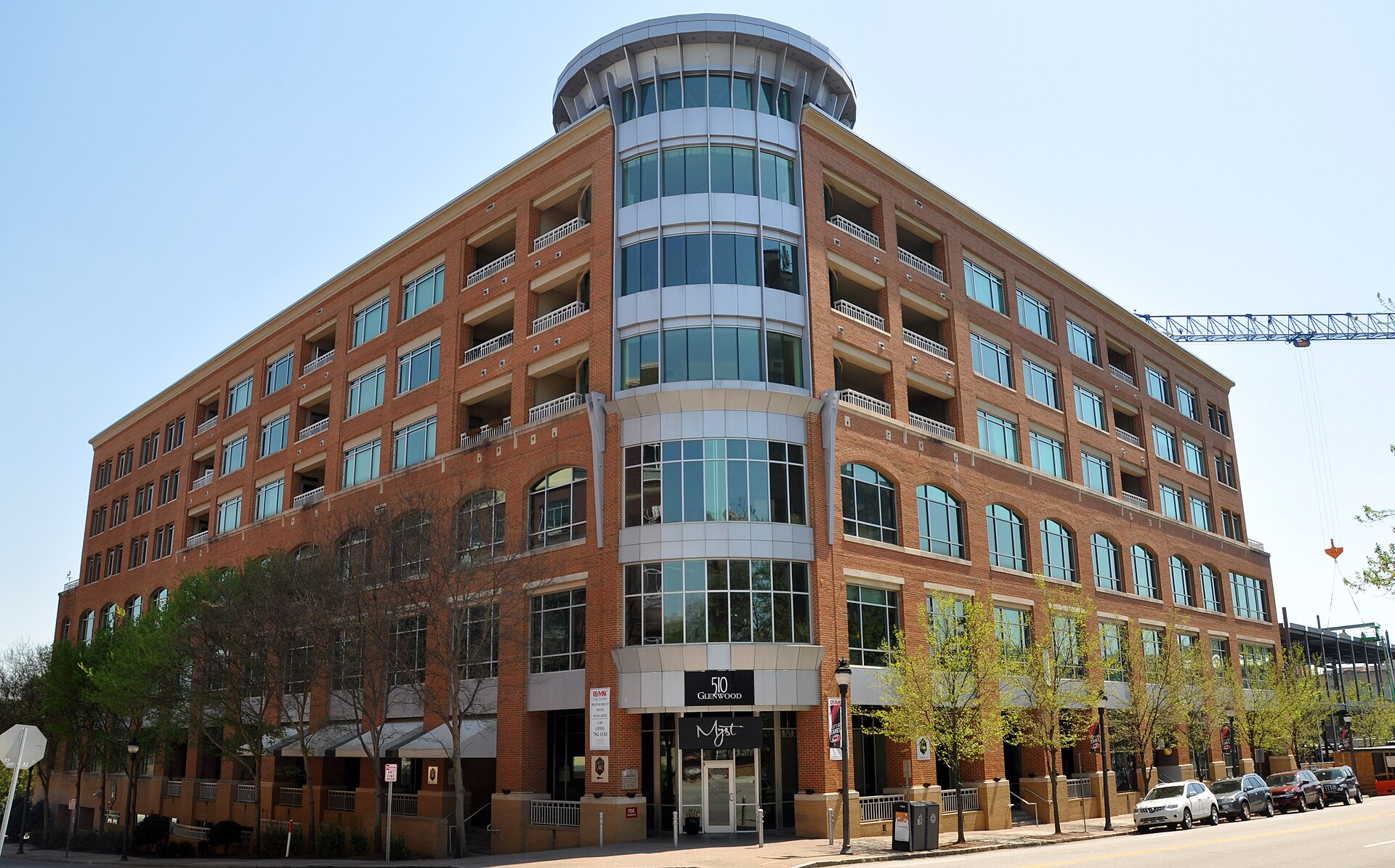
Condos are the main product, and the ladder runs from about $300,000 for a one-bedroom in an older building such as the Dawson, the Hudson or Palladium Plaza, to $450,000 to $800,000 for two-bedrooms in the Glenwood South and Fayetteville Street towers, to $1 million to $1.5 million and up for penthouses at PNC Plaza, West at North and the newest buildings (Tidal Realty Partners Downtown Raleigh guide, Triangle MLS, November 2026). New townhomes in Glenwood-Brooklyn, East Raleigh and Seaboard Station run $550,000 to $900,000, and the historic houses in Oakwood, Boylan Heights and Mordecai start in the $600,000s for small cottages and reach $1.2 million to $1.8 million for restored Victorians. Across the city, Raleigh’s trailing 12-month median is about $448,000 with an average of 51 days on market, and the Census puts the typical Raleigh owner-occupied home at $415,800 (ACS 2024 five-year estimates).
Then come the dues. Full-service towers charge the most, and across downtown we tell buyers to expect $350 to $800 a month (Downtown Raleigh guide FAQ). Property tax is the combined Wake County and City of Raleigh rate of about 91 cents per $100 for 2026, plus a small downtown municipal service district levy on properties inside that district. Put it together on a $450,000 two-bedroom with 20 percent down at 7.11 percent (Freddie Mac PMMS, November 12, 2026): about $2,422 a month in principal and interest, roughly $341 in property tax, and call it $500 in dues, for about $3,260 before insurance. That is well above the $1,879 average rent the Alliance reports, which is the math behind most downtown residents renting. We lay out the full Wake County market picture every month, and the New York relocation guide covers what those numbers feel like coming from a Manhattan or Brooklyn budget.
Is downtown Raleigh safe and quiet enough to live in?
Safe enough, mostly, and not quiet. The Alliance’s own president told WUNC in August that perceptions of public safety are downtown’s biggest challenge, citing large drug arrests in Moore Square and a violent teen gathering in July, while saying the overall crime rate is down (WUNC, August 26, 2026). That matches what our downtown clients report: the Fayetteville Street core and Glenwood South feel busy and watched, Moore Square and the blocks east of it after dark are where people hesitate, and the Warehouse District in between has improved the most. Noise is the other honest warning. A Glenwood South balcony on a Saturday night is a different purchase from a Seaboard Station townhome, and a unit facing the new amphitheater site will hear 2027’s concert season. Walk the block at 11 p.m. on a Friday before you write an offer.
The alternative that keeps winning our comparisons is the ring of historic neighborhoods a 10- to 20-minute walk from the center. Five Points, Oakwood and Boylan Heights give you a yard, a front porch and a walk to the same restaurants without the dues, at a higher price and with 1920s plumbing. For buyers who want new construction with elevators and parking but a quieter street, North Hills is the usual answer, about ten minutes north.
Downtown condos are a thin market. The Alliance counts 274 condos and townhomes built since 2015 against 6,649 apartments, so there are few new units, and resale depends on each building’s reputation, reserves and rental share. Lenders look at those numbers too: a building with a high share of rented units or underfunded reserves can fail a conventional loan’s warrantability review, which narrows your buyer pool when you sell. Dues also rise with insurance and elevator costs and never go back down. If you expect to move in under five years, or you want the house to be your main investment, we will usually point you to a townhome in Seaboard Station or a resale house in Five Points instead. If you want to live downtown for the way it feels on a Thursday night, nothing else in the Triangle does that.
Related questions people also ask
How much does a condo cost in downtown Raleigh?
One-bedroom condos in older downtown buildings such as the Dawson, the Hudson and Palladium Plaza start around $300,000, two-bedrooms in the Glenwood South and Fayetteville Street towers run $450,000 to $800,000, and penthouses at PNC Plaza, West at North and the newest buildings reach $1 million to $1.5 million and above (Tidal Realty Partners Downtown Raleigh guide, Triangle MLS, November 2026). Monthly HOA dues of $350 to $800 come on top of the purchase price.
Is downtown Raleigh safe?
Overall crime downtown is down according to the Downtown Raleigh Alliance, but its president has said that the perception of safety is the district’s biggest challenge, pointing to drug arrests in Moore Square and a violent teen gathering in July 2026 (WUNC, August 26, 2026). In practice, Fayetteville Street, Glenwood South and the Warehouse District feel busy and well-watched most evenings, while the blocks around and east of Moore Square are where residents are most cautious after dark.
Is downtown Raleigh walkable?
Yes, within its core. Fayetteville Street, Glenwood South, the Warehouse District, Moore Square and Seaboard Station are all within a 10- to 20-minute walk of one another, with the Transfer Co. and Morgan Street food halls, Union Station, the performing arts center and Dorothea Dix Park’s 308 acres on the south edge (Tidal Realty Partners Downtown Raleigh guide). Most residents still keep a car for RTP, the airport and big-box errands, and most towers charge for deeded parking.
Tell us your budget, how long you plan to stay and whether you need parking and an elevator, and we will send you the current downtown condo and townhome inventory with each building’s dues, rental share and recent resales, next to the Five Points and Seaboard Station alternatives at the same monthly cost. Talk it through with our team before you commit to a building you have only seen on a Saturday afternoon.
Sources: Downtown Raleigh Alliance, State of Downtown Raleigh 2026 report, presented August 26, 2026 (via the Alliance’s recap and WUNC coverage); WUNC, “Economic development report: Downtown Raleigh’s growth depends on new residents and visitors,” August 26, 2026; Raleigh Magazine, “Downtown Raleigh Q3 by the Numbers,” November 16, 2026, summarizing the Downtown Raleigh Alliance Q3 2026 Market Report; City of Raleigh, Amphitheater Relocation and Convention Center Expansion project page, read November 19, 2026; Tidal Realty Partners Downtown Raleigh neighborhood guide, Triangle MLS trailing 12-month data, November 2026; Tidal Realty Partners Wake County market page, Triangle MLS October 2026; U.S. Census Bureau ACS 2024 five-year estimates via Census Reporter (Raleigh median home value), read November 19, 2026; Wake County Tax Administration 2026 rate table and City of Raleigh FY2026-27 rate via our Downtown Raleigh guide; Freddie Mac Primary Mortgage Market Survey, November 12, 2026; monthly cost figures are our own calculations from those sources.