Usually yes, but on the builder’s terms and by appointment rather than whenever you are driving past. The visit worth fighting for is the one between the framing inspection and the day insulation goes in, because that is the only window in which anyone can see how your house was actually assembled.
Buyers under contract on a new build in Riverlights, Brunswick Forest or Hampstead ask us this within the first month, usually after driving by on a Saturday and finding a locked gate or a sign telling them to stay out. The sign is not personal. An active job site is a workplace, the builder carries the liability for who is on it, and most builder contracts say so.
What that means in practice is that site access is negotiated, not assumed. And the timing matters more than the number of visits.
The window that actually matters
Local building departments inspect a house in a fixed order, and the order tells you exactly when to be standing in it. Brunswick County’s Code Administration publishes the sequence in its residential building inspection guide: footing, under slab or monolithic slab, foundation, trade rough-ins, then the building framing inspection, then insulation, then the finals.
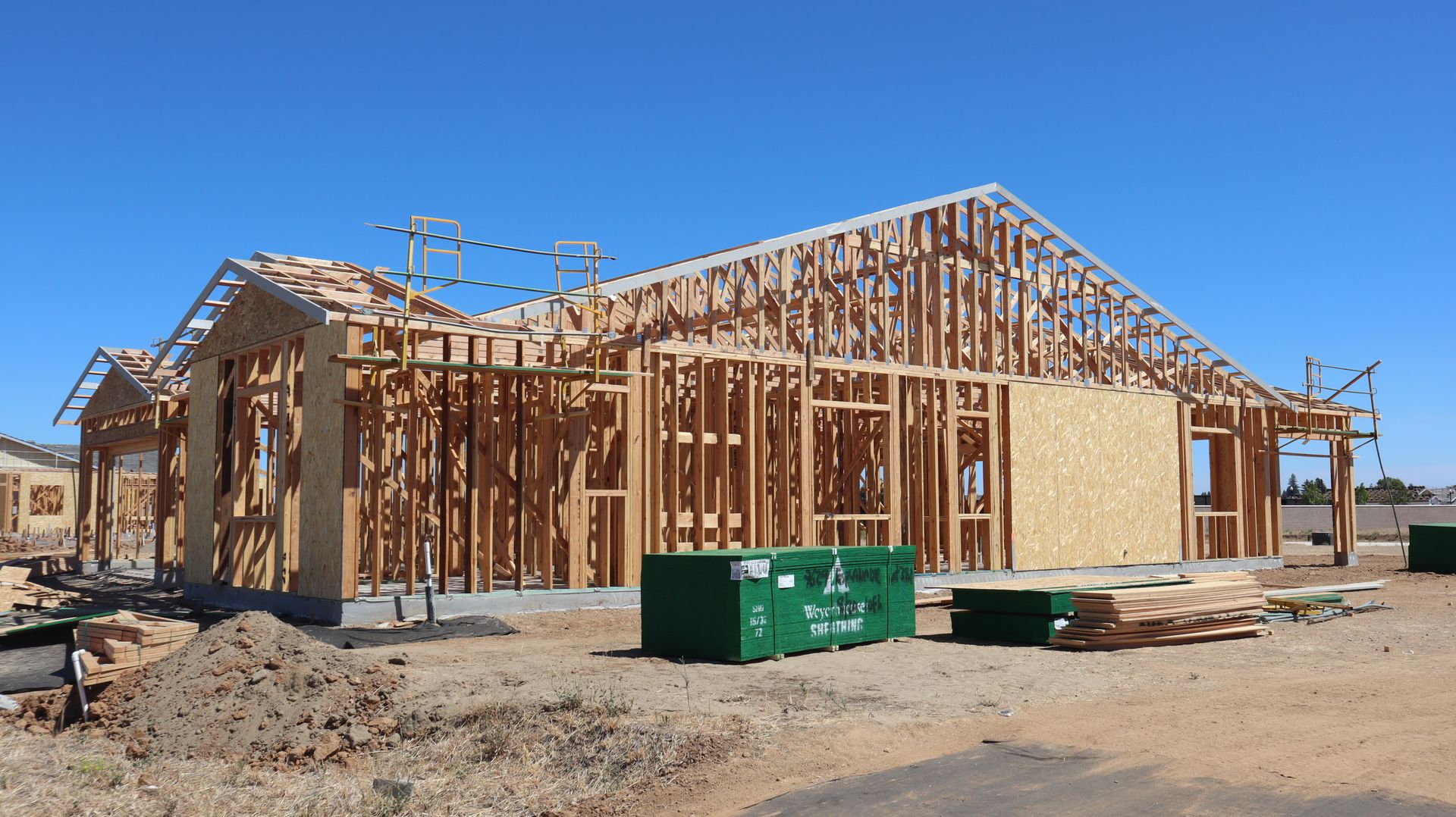
The framing inspection, in the county’s own words, is “to be scheduled after all trade rough ins are complete and the roof, wall, ceiling, and floor framing is complete with appropriate blocking, bracing and fire stopping in place.” The insulation inspection comes “after an approved building framing and trade rough-in inspections and before any wall or ceiling covering is applied.”
Between those two inspections, the house stands open. Plumbing runs, ductwork, electrical, the roof deck, the flashing at wall openings, the blocking in the walls. Everything that will be invisible for the rest of the building’s life is visible right then. After the insulation inspection, the drywall goes up and the window closes.
- The framing inspection is scheduled after all trade rough-ins are complete and the roof, wall, ceiling and floor framing is finished with blocking, bracing and fire stopping in place Brunswick County Code Administration, Residential Building Inspection Step-by-Step Guide, 8/10/21
- The insulation inspection follows an approved framing and rough-in inspection and comes before any wall or ceiling covering is applied Brunswick County Code Administration, Residential Building Inspection Step-by-Step Guide, 8/10/21
- Items the county requires to be visible at framing include pipes, chimneys and vents, flashing for roofs, chimneys and wall openings, insulation baffles, and lintels bolted to the framing Brunswick County Code Administration, Residential Building Inspection Step-by-Step Guide, 8/10/21
- Across 2,481 new single-family homes finaled in New Hanover County since January 2024, the median build ran 217 days from permit issue to final inspection, with the middle half between 147 and 295 days New Hanover County GIS building permit records, queried November 20, 2026
That last number is why you cannot plan this loosely. A house that takes seven months spends a matter of days in the pre-drywall state. Miss it by a week and you are looking at painted walls.
How to get the visit, and how to use it
Ask at contract signing, not at framing. The question to put to the builder’s sales agent in writing is simple: what site visits are permitted, who has to accompany me, and will you give me notice before insulation is installed? Most builders in our market will schedule a pre-drywall walk with the construction superintendent if you ask early. Some require a signed waiver, hard hats and closed-toe shoes. Some will not allow you on the site unescorted at any stage, and that is their right.
Then use the visit properly. A walk with the superintendent is useful for orientation, but it is not an inspection. We tell buyers to bring their own licensed inspector to the pre-drywall stage, because the county inspector is checking code compliance and not whether your HVAC was sized correctly or whether flashing went on the way the manufacturer specifies. Those are different questions and only one of them is being asked by the person with the clipboard.
Photograph everything while the walls are open. Photograph where the plumbing and electrical runs sit in each wall. In five years, when you want to hang a heavy mirror or move a light, those photographs will be the most useful thing you own.
Our new construction guide lays out the three inspections we tell every coastal buyer to get, and our new construction page covers the builders we work with across the three counties. If you are still weighing a build against an existing house, our new construction versus resale comparison goes through the tradeoffs, and how long it takes to build a house in Wilmington has the full timeline from the county’s permit record.
A builder who says no is not necessarily being unreasonable. Insurance carriers and site safety rules drive a lot of these policies, and a superintendent managing fourteen houses cannot escort fourteen buyers whenever they like. The harder problem is what happens when your inspector finds something. A pre-drywall report that lists real defects is only worth having if your contract gives you a way to require the fix, and many builder contracts route that through their warranty process rather than through a repair negotiation. Read that language before you sign, not after the report lands. And be honest about the social cost: pushing hard at the pre-drywall stage can strain the relationship with the person building your house. We think it is worth it, and we think the way to do it is through your agent and in writing rather than in a confrontation on the job site.
Related questions people also ask
What is a pre-drywall inspection?
It is an inspection by your own licensed inspector after framing and rough-ins are complete and before insulation and drywall go in. The inspector looks at structural framing, the building envelope, and how the plumbing, electrical and mechanical systems were installed while all of it is still exposed. It is separate from the county’s framing inspection, which checks compliance with the building code rather than workmanship on your behalf. Once drywall is up, none of it can be seen again without opening a wall.
Can the builder refuse to let me on the job site?
Yes. The builder controls the site until closing and carries the liability for anyone on it, so access terms come from your purchase agreement and the builder’s own safety policy. Most builders will accommodate scheduled, escorted visits if you ask at contract rather than mid-build. If site access matters to you, raise it before you sign, because it is much easier to negotiate then than to argue about later.
Should I hire my own inspector on a brand new house?
We think so, and we recommend it even though the home is new and the county is inspecting it. A municipal inspector verifies code compliance across many houses in a day, while your inspector works only for you and looks at quality as well as compliance. On a coastal build, flashing details, envelope sealing and HVAC sizing are the items that cause expensive problems later. The cost of the inspection is small next to the cost of finding those things in year three.
Ask your builder in writing, today, for their site visit policy and for notice before insulation goes in, then book your own pre-drywall inspector as soon as you have a framing date. Those two emails are the difference between seeing your house built and seeing it finished. We schedule these walks for our new construction buyers as a matter of course, and we are glad to talk through how it works on your specific community and builder.
Sources: Brunswick County Code Administration, Residential Building Inspection Step-by-Step Guide, dated 8/10/21, read November 20, 2026. New Hanover County GIS building permit records, new single-family permits issued since January 2, 2024 with a recorded final date, queried November 20, 2026. Tidal Realty Partners new construction guide.